September 3, 2026
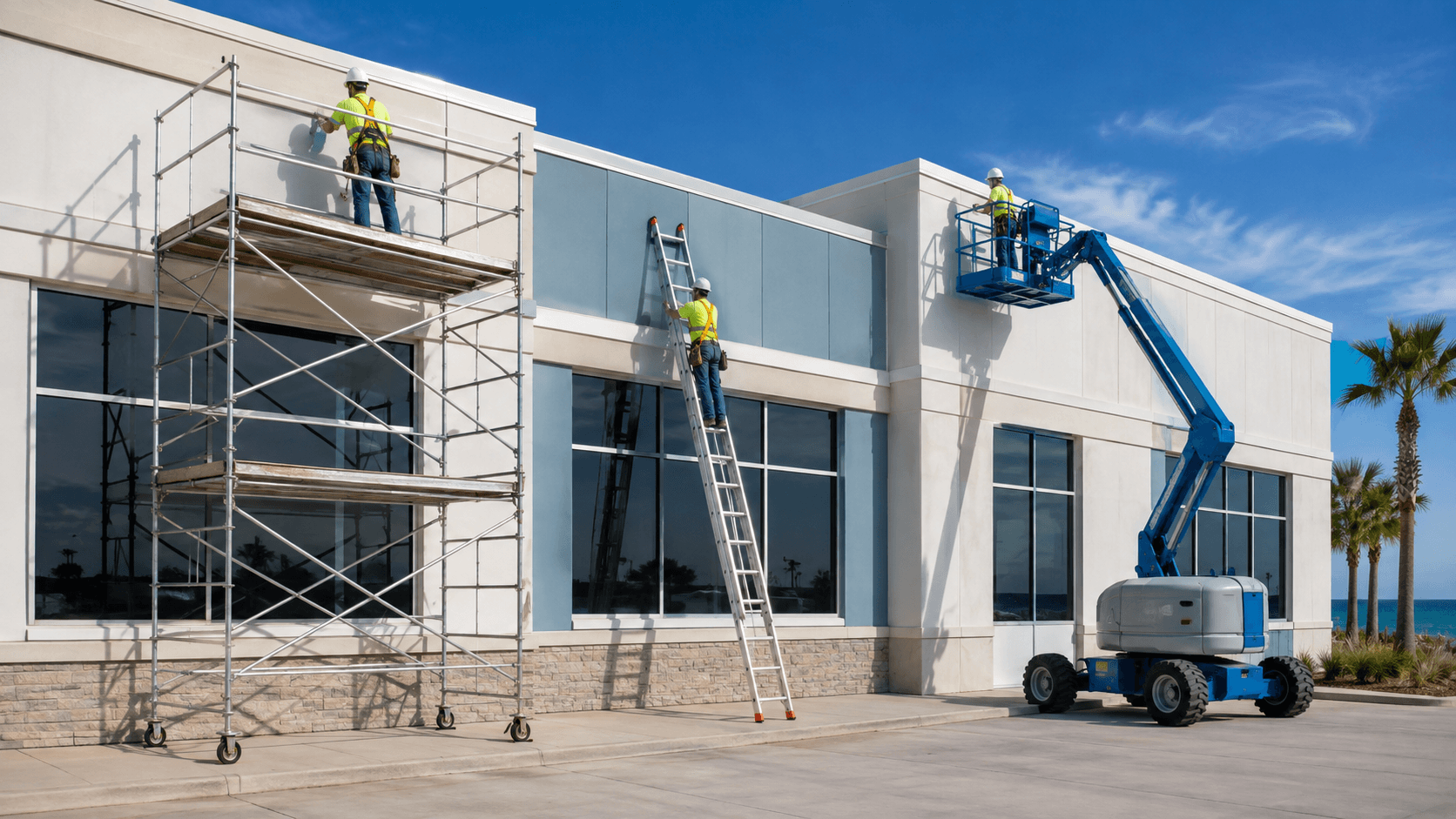
The Best Access Option Depends on How You Will Work
Reaching the work is only one part of choosing access equipment. You also need to consider how long the job will take, how often workers must reposition, whether materials need to travel with them, what the ground looks like, and whether an obstacle sits between the setup area and the work.
For projects in Panama City and across Northwest Florida, the choice often comes down to a ladder rental, a scaffolding rental, a scissor lift, or a boom lift. None is automatically best for every project. The right choice is the one designed for the work pattern and approved for the site.
When a Ladder Rental Makes Sense
A ladder is typically the simplest option for short-duration, light-duty work when the worker can maintain safe contact and does not need a broad platform. Examples may include an inspection, a quick touch-up, changing a fixture, cleaning a reachable area, or completing a small punch-list item.
A Ladder Is Usually a Better Fit When
- The task is brief and limited to one small work area.
- The worker needs few tools and can keep hands available for safe climbing.
- Firm, level setup space is available at the correct angle and distance.
- The ladder can be moved without placing it near doors, traffic, electrical hazards, or unstable surfaces.
Yesco offers step ladders and extension ladders in several heights. A taller ladder is not automatically the safer answer. Choose the type and size based on the actual working height and setup conditions, not simply the highest point listed on the ladder.
When Scaffolding Is the Better Choice
Scaffolding creates a larger working platform and can provide continuous access across a section of a structure. That makes it useful when a crew will spend extended time painting, installing siding, repairing masonry, replacing windows, working on mechanical systems, or moving along a commercial facade.
Scaffolding Often Fits Projects That Need
- A stable work platform for longer-duration tasks.
- Room for workers, tools, and approved material loads.
- Access across a wall, roof edge, industrial system, or irregular structure.
- A planned setup that can remain in place while work progresses through multiple stages.
- Professional delivery, erection, dismantling, and pickup coordinated with the project schedule.
Yesco provides frame and brace, system, multi-function, and shoring options for different applications. The scaffolding rental team can review the structure, working height, access points, load needs, ground conditions, schedule, and project type before recommending a configuration.
When a Scissor Lift Works Best
A scissor lift moves primarily up and down, creating an elevated platform directly above its base. It can work well for interior maintenance, warehouse tasks, overhead electrical or mechanical work, and other jobs where the machine can be positioned beneath the work on a suitable surface.
Yesco’s 19-foot Skyjack scissor lift has a listed maximum working height of 25 feet and a two-person platform capacity. Equipment specifications are only part of the decision. Door clearances, floor loading, surface conditions, travel path, overhead obstructions, and operator requirements also need to be checked.
When a Boom Lift Is the Better Fit
A boom lift is designed to provide vertical reach plus outreach, which may help when the base cannot sit directly below the work. That can make a boom lift useful for exterior maintenance, signs, tree-adjacent work, building features, or areas separated from the setup point by landscaping or another obstacle.
Yesco’s lift inventory includes the Nifty TM34 and the Nifty TM50. The TM34 lists a working height of 40 feet 6 inches and outreach of 16 feet 6 inches. The TM50 lists a working height of 56 feet and outreach of 28 feet 6 inches. Use these figures as a starting point, then confirm the full setup envelope, ground support, clearance, slope, wind limits, and operator qualifications for the job.
Quick Comparison: Ladder, Scaffolding, Scissor Lift, or Boom Lift
| Option | Best Work Pattern | Main Advantage | Key Site Question |
| Ladder | Brief work in a small area | Simple setup and easy repositioning | Is there firm, level room for the correct setup? |
| Scaffolding | Longer work across a wall or structure | Broad, continuous platform access | Can the scaffold be planned, supported, and tied as required? |
| Scissor lift | Repeated vertical work above the base | Platform can rise and reposition on a suitable route | Can the machine travel and operate on the available surface? |
| Boom lift | Targeted work requiring vertical and horizontal reach | Reaches up and around obstacles | Is there enough setup space, clearance, and ground support? |
Questions to Answer Before Renting Access Equipment
- What is the working height, not just the height of the wall or ceiling?
- How long will workers remain in each area, and how often must they move?
- How many workers, tools, and materials must the platform support?
- Is the surface firm, level, and capable of supporting the selected equipment?
- Are there overhead power lines, doors, pedestrians, vehicles, landscaping, or other obstacles?
- Will the equipment be used indoors, outdoors, or in a coastal area exposed to changing wind and weather?
- Who will operate or use the equipment, and what training or site controls are required?
Do Not Choose on Height Alone
Two pieces of equipment may reach the same elevation and still serve very different jobs. A ladder may reach a second-story area, but it does not provide the same work platform as scaffolding. A scissor lift may provide a comfortable platform, but it cannot reach around an obstacle like a boom lift. Scaffolding can support continuous work across a facade, but it requires a planned layout and setup period.
Cost should be compared using the full job, including setup, delivery, labor efficiency, repositioning, accessories, site controls, and rental duration. The lowest daily rate may not be the lowest total project cost if the equipment slows the crew or does not fit the site.
Get a Local Recommendation for Your Panama City Project
A few clear project details can make the rental conversation much more useful. Measure the approximate working height, take photos of the setup area, note the ground or floor surface, identify obstacles, and estimate how long the work will last. For scaffolding, include the length and shape of the area that needs access. For a lift, include the travel path and required outreach.
Contact Yesco or call (850) 277-0000 to discuss ladder, lift, or scaffolding rentals in Panama City and across the surrounding service area.
Access Equipment Rental FAQs
Is scaffolding safer than a ladder?
Scaffolding and ladders are designed for different work. Scaffolding may provide a larger platform for extended tasks, while a ladder may be appropriate for brief, light work. Safety depends on choosing the correct equipment, following the manufacturer’s instructions and applicable rules, inspecting the setup, and controlling site hazards.
Should I rent a scissor lift or boom lift?
Choose a scissor lift when the machine can sit beneath the work and vertical platform travel fits the task. Consider a boom lift when you need outreach to reach above or around an obstacle. Working height, platform capacity, surface, slope, clearances, and operator qualifications all matter.
Does Yesco set up rental scaffolding?
Yesco offers delivery, professional erection, dismantling, and pickup for its scaffolding rentals. The exact scope and schedule should be confirmed as part of the quote for your project.